
Race Predictor
Predict your finish times and target paces for standard race distances using Riegel's Formula.
Your Baseline Performance
Enter a recent race or training result to calibrate the formula.
Predicted Finish Times
Calculated predictions for standard distances.
| Distance | Predicted Time | Avg Pace |
|---|---|---|
| Enter your baseline performance on the left to see predictions | ||
When preparing for a race, one of the biggest challenges is setting a realistic target time. Start too fast and you’ll hit the wall; start too slow and you’ll finish wishing you had pushed harder.
The interactive Race Predictor calculator above uses a mathematical model to estimate your race times across various distances based on your recent performances. Here is a breakdown of how the mathematics works, the limitations of manual calculations, and how Apex Run automates the entire process.
How Does it Work? Riegel’s Formula#
At its core, race prediction is powered by Riegel’s Formula, a mathematically proven model developed by research engineer Peter Riegel in 1977. It has since become the gold standard for predicting race times across different endurance distances.
The formula is expressed as:
T2 = T1 × (D2 / D1)^d
Where:
- T1: Your known time for a baseline run (e.g., your recent 10K time).
- D1: The distance of that baseline run.
- D2: The target distance of the race you want to predict (e.g., a Half Marathon).
- T2: The predicted finish time for the target distance.
- d: The fatigue exponent (representing how much pace you lose as the distance increases).
Understanding the Fatigue Exponent (d)#
The default exponent developed by Riegel is 1.06, which represents the fatigue curve of an average, well-trained runner. However, runners are not identical:
- Endurance Specialist (d = 1.04): High-mileage runners who excel at longer distances. They lose very little speed as they transition from a 10K to a Marathon.
- Balanced (d = 1.06): The standard curve for most runners with a healthy mix of speed and aerobic foundation.
- Speed Specialist (d = 1.08): Runners with great short-distance speed (like 1500m or 5K) who drop off more rapidly in endurance events like the Marathon due to lower aerobic volume.
The Limitations of Manual Calculators#
While the interactive tool above is great for quick estimations, manual calculators suffer from two major flaws:
- Choosing the Right Exponent (d): Unless you mathematically calculate your pace drop-off across multiple recent races, you have to guess whether you are a 1.04, 1.06, or 1.08 runner.
- Selecting the Representative Baseline (T1): If you use a personal record (PR) from a year ago when you were fitter, your predictions will be dangerously optimistic. If you use a casual recovery run, they will be far too slow.
The Apex Run Solution: Automated Calibration#
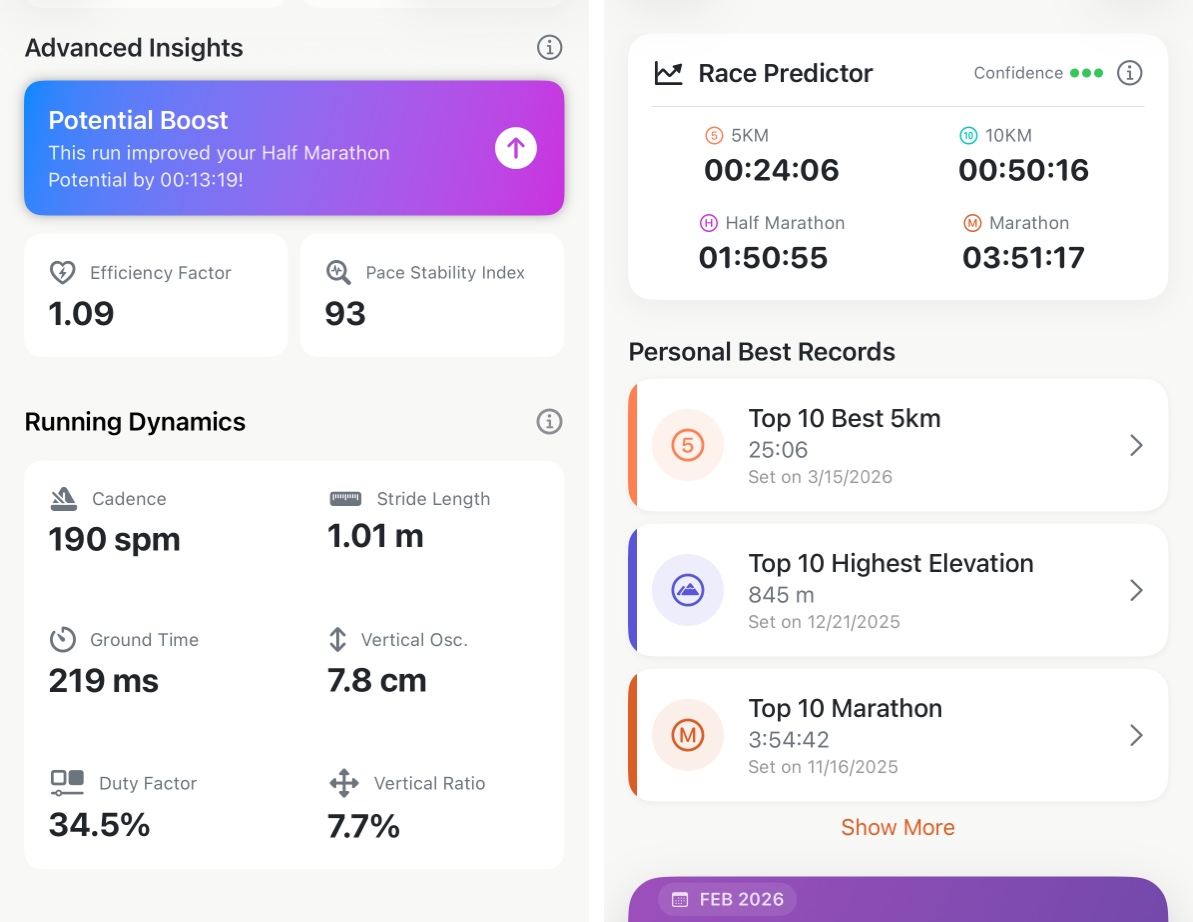
The Apex Run App solves these limitations by replacing guesswork with real-time data analysis.
Instead of requiring you to input arbitrary PRs or guess your exponent, Apex Run scans your last 6 weeks of real training data on your sports watch:
- Smart Baseline Selection: It filters out easy recovery jogs, interval rests, and warmups, identifying your most representative efforts to establish T1 and D1.
- Personal Exponent Calibration: By comparing your paces across different distances during training, it calculates your exact, personal fatigue exponent (d) rather than using a generic 1.06.
- Automatic Updating: Apex Run refreshes predictions as new runs arrive, giving you a current model estimate rather than a guaranteed race outcome.
Frequently Asked Questions#
Why is my predicted time slower than my all-time PB?
“PB represents your peak historical fitness; predictions reflect your current readiness.”
Your fitness naturally fluctuates through training cycles (Base, Build, Peak, and Recovery). Because Apex Run focuses on your most recent 6 weeks of training, your predictions will reflect your current aerobic base. As you complete high-intensity speed workouts and taper towards race day, your predictions will naturally trend back upward to meet your peak capacity.
How accurate is Riegel’s Formula for a Marathon?
Riegel’s Formula assumes proper aerobic training for the target distance. If you base your Marathon prediction on a fast 5K, but your longest training run has only been 10K, your body will experience much higher fatigue than the formula predicts. For accurate marathon predictions, ensure your training volume includes long runs to match your baseline aerobic endurance.
- Find out what you could run today Signing up for something in eight weeks and no idea what number to put next to your name? Apex Run already has six weeks of your running. It turns that into four finish times, and tells you how much to trust each one.