
Some days the weather gives you a hard number before you’ve run a single kilometre. Today’s was 83%.
But before I even checked the weather, the app had already said something worth listening to. Last night’s sleep was mediocre — and this morning’s HRV came in at the lower edge of my baseline band. Not suppressed enough to skip the session, but a clear signal: don’t push today. (The Recovery feature is how I read that signal every morning.)
So I already had one constraint going in: keep it aerobic, keep it controlled. Then I stepped out at 8:19 into 26°C air that felt more like a wet towel than a morning. By the 2km mark I was completely soaked. The original distance plan went out the window — not out of weakness, but out of arithmetic. Running another 5–8km in 83% humidity on top of a low HRV day would have been fighting two signals at once.
So the goal shifted: 18km, controlled drift, form intact at the finish.
Reading the Heart Rate Curve#
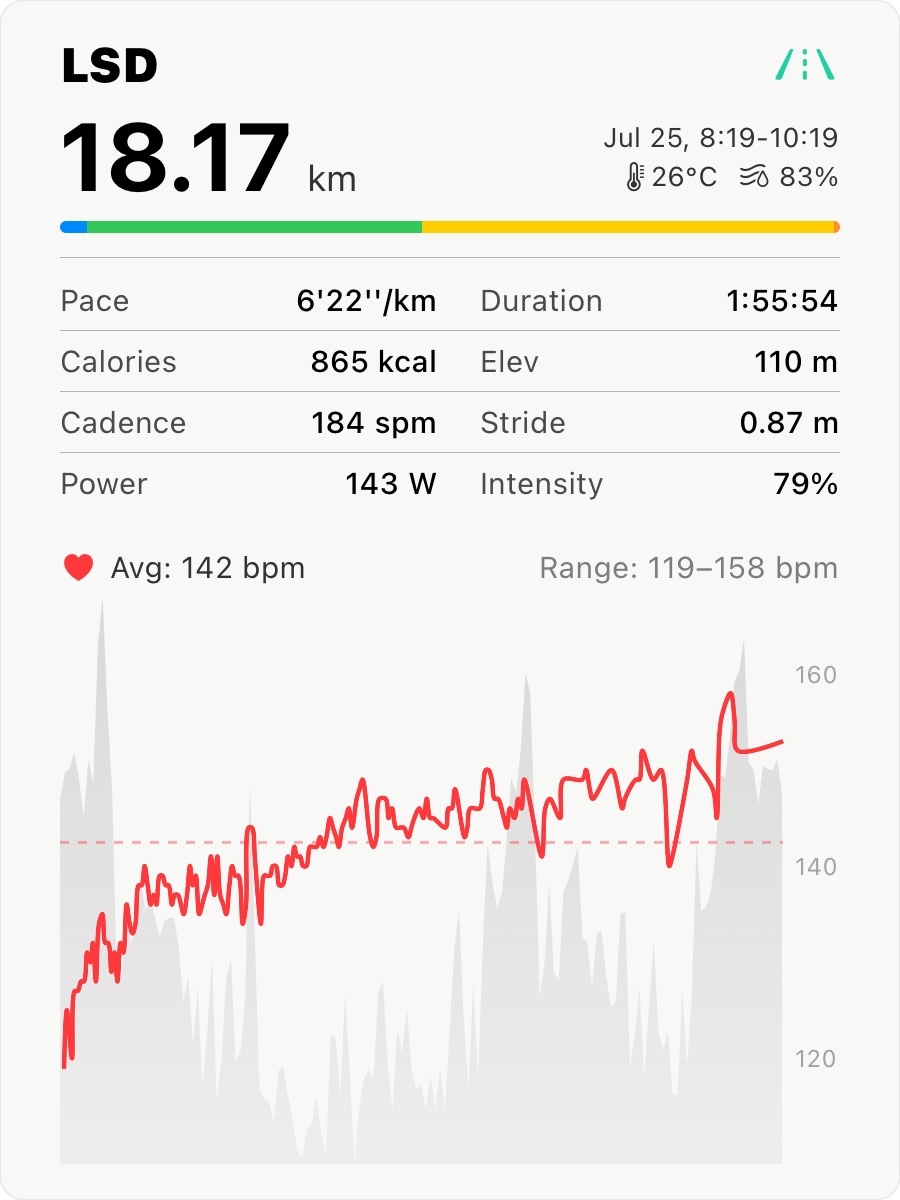
The HR chart tells the story more honestly than any subjective note.
The curve rises steadily from the first kilometre — no flat warmup plateau, straight into cardiac drift from the humidity. It stabilised somewhere around 140 bpm through the middle section, hovering near the session average. The last 2–3km saw it push toward the 155–158 range, but it didn’t spike or go chaotic. That’s the signal I was looking for: drift present, but not runaway.
An average of 142 bpm sits just inside Zone 3 (Zone 2 ceiling is 139). But the zone distribution bar tells a more complete story: the largest segment is green — the bulk of the run’s time was spent in Zone 2, before drift pulled the average up in the back half. On a cooler day, the same effort at this pace would likely hold 130–132 throughout — solidly Zone 2 start to finish. The humidity cost roughly 10 bpm of overhead today. You pay for the heat in heart rate; the pace stays the same, the cardiovascular load is higher. That’s not a bad session. That’s honest accounting.
Form to the End#
The second goal was keeping form control through the final kilometres. In humid heat, the breakdown usually starts quietly: shoulders creep up, stride shortens, the lean goes passive. Today it didn’t. Cadence held at 184 spm — consistent with recent runs — and the stride felt active rather than shuffling in the last stretch.
Finishing without that depleted feeling was the confirmation. Not because the run was easy — it wasn’t — but because the load was calibrated right.
What the Data Says#
A 79% intensity reading with an average of 142 bpm and 143W output is a coherent picture: moderate-high aerobic stress, not anaerobic, not junk. For a summer LSD in these conditions, that’s exactly where this session should sit.
The goal was always aerobic base. The base is being built. The heat is just the medium we’re building it in.
Next session: recovery or easy short run depending on how the legs feel tomorrow morning.