
Post-travel jet lag and heavy legs from tens of thousands of daily walking steps: the easy mistake is to either shut down completely or force through the fatigue.
Instead, I trusted active recovery — pure Zone 1–2 easy jogs paired with daily yoga and stretching. By Thursday, running at the exact same 6'14’’ pace saw heart rate drop from Monday’s 141 bpm down to 133 bpm.
Today was the test: a 21.46km Sunday LSD in crisp 18°C morning air to wrap up a 74.56km week.
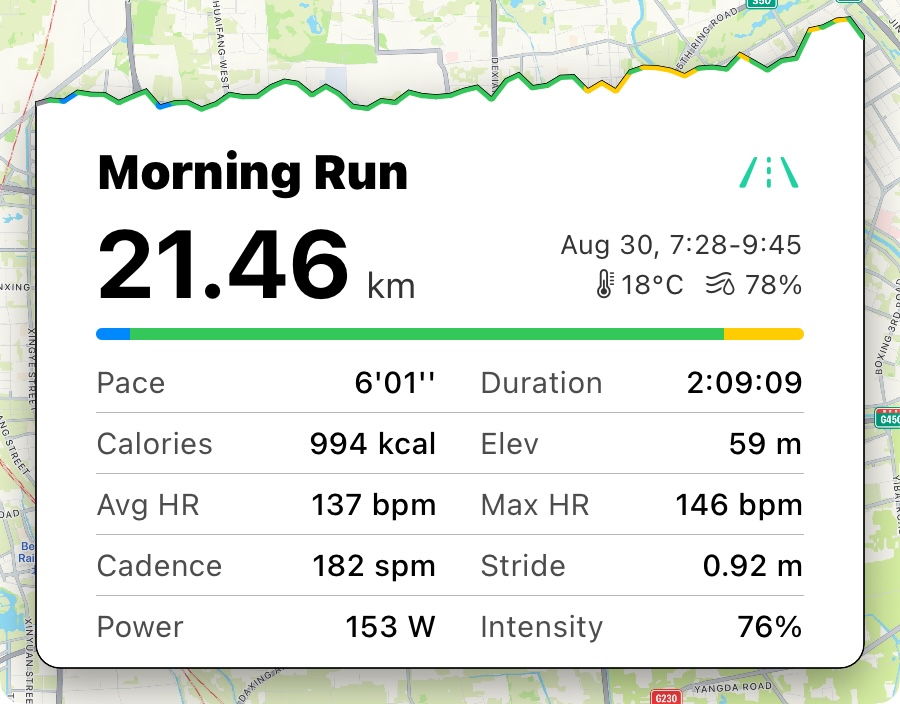
21.46km in 2:09:09#
Stepping out at 7:28 AM in 18°C and 78% humidity, the goal was purely aerobic volume without pushing pace.
- Pace & Effort: Settled naturally at 6'01’’/km with an average HR of 137 bpm (Max 146 bpm, 76% intensity). The zone bar was overwhelmingly green (Zone 2).
- Rhythm: Held a rock-solid 182 spm cadence throughout the 2 hours, with 0.92m stride length and 153W power.
- Feeling: Zero quad tightness or late-stage form collapse over the final 4 kilometres.
7 Days, 74.56km: The Recovery Curve#
Closing the week with 7 consecutive running days (7:46:10 total time) felt especially good given where it started.
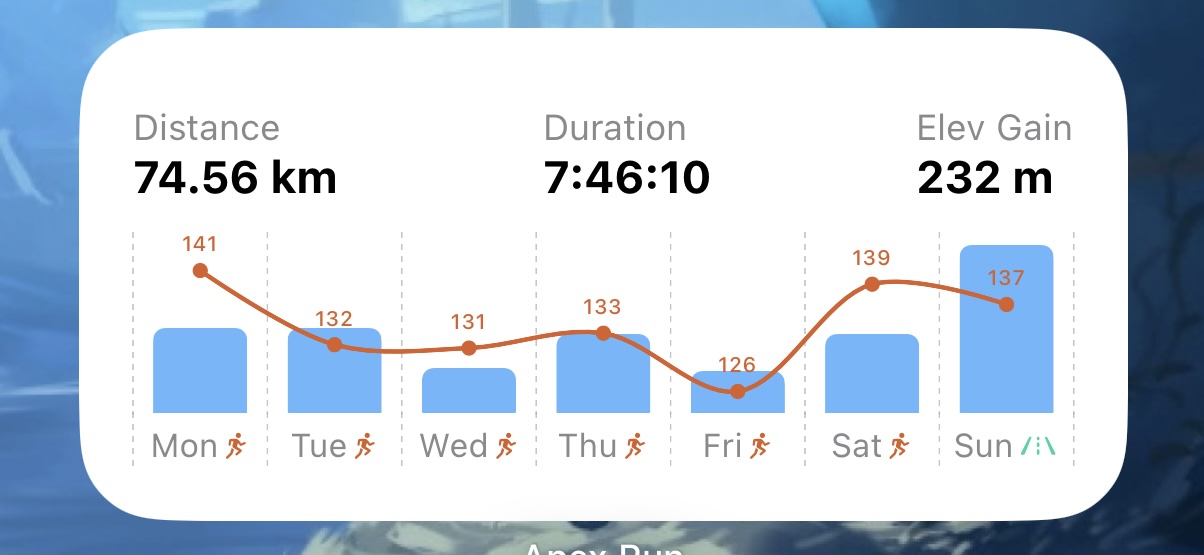
The weekly heart rate trend maps the recovery curve clearly:
- Mon (141 bpm): Peak travel fatigue and heavy legs.
- Tue–Thu (132 → 131 → 133 bpm): Active recovery jogs and yoga flushing out fatigue.
- Fri (126 bpm): Systemic reset, minimal cardiovascular strain.
- Sat–Sun (139 → 137 bpm): Priming run followed by an effortless 21.46km half marathon long run.
Slow, disciplined miles don’t just maintain fitness — they actively restore it. Respect what your body tells you on Monday, and it rewards you with a great long run on Sunday.
Previous log: August 15 Half Marathon — Race day recap and pacing execution.