
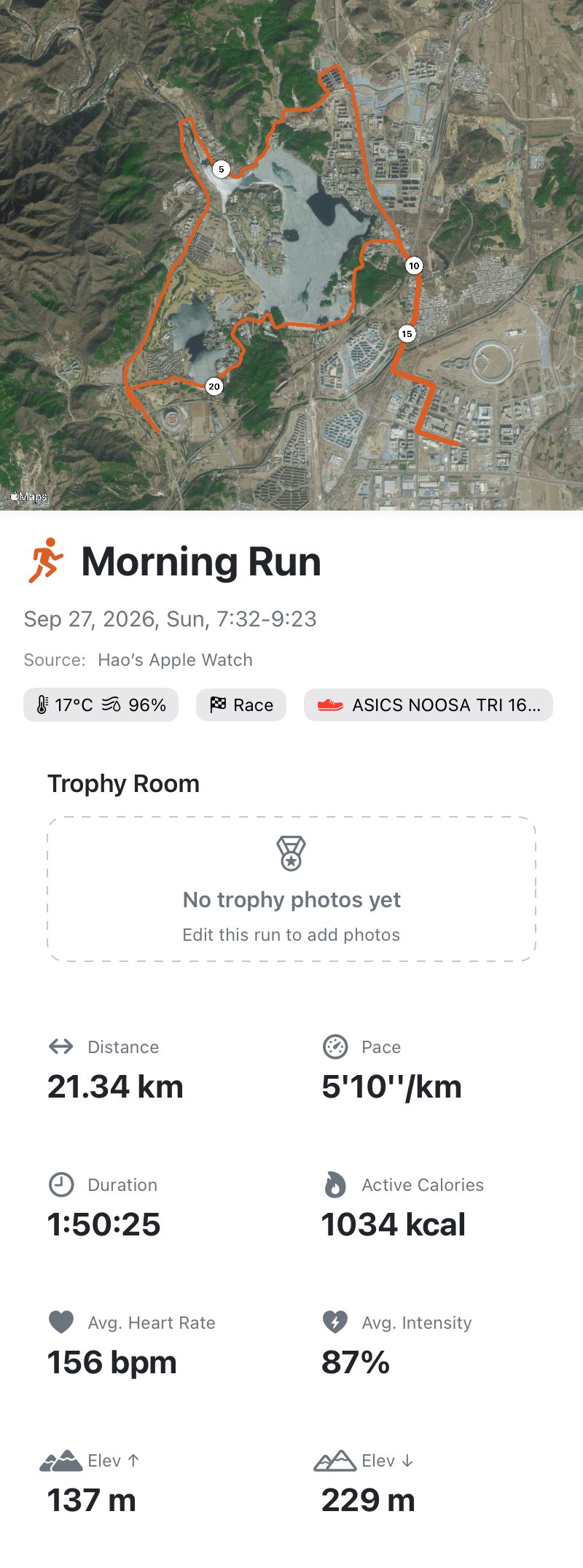
Race morning arrived with ideal autumn conditions: 17°C, overcast skies, and 96% humidity. Lacing up the ASICS Noosa Tri 16, I lined up alongside a good running friend for our local half marathon loop around the lake and foothills.
He was aiming for a fast race, while my goal was straightforward: run a steady, disciplined effort, stay composed on the hills, and see how fitness compared to last year’s performance on this exact same course.
The overall outcome: 21.34 km in 1:50:25 (average pace 5'10’’/km, GAP 5'06’’/km), holding an average heart rate of 156 bpm and an average cadence of 192 spm.
Compared to running this same loop last year, today was two minutes faster — setting a new personal route benchmark. Across all races, it landed just half a minute shy of my all-time half marathon PB (1:49:11).
5K Split Breakdown: The Km 17 Climb#
The course features rolling terrain with 137m of elevation gain and 229m of descent. Breaking the race down into 5K blocks shows a remarkably even aerobic distribution:
| Segment | Distance | Time | Pace | Avg HR | Elevation & Terrain Context |
|---|---|---|---|---|---|
| 0 – 5 km | 5.00 km | 25:09 | 5'01’’ / km | 158 bpm | Settling after the crowd; Km 1 at 5'16’’, then locking into 4'52’’–5'07’’ rhythm |
| 5 – 10 km | 5.00 km | 25:27 | 5'05’’ / km | 155 bpm | Rolling lakeside stretch (+14m at Km 6, -21m at Km 7); heart rate dropping to 155 bpm |
| 10 – 15 km | 5.00 km | 25:45 | 5'09’’ / km | 155 bpm | Steady cruising rhythm; cardiovascular load flat at 154–155 bpm |
| 15 – 20 km | 5.00 km | 26:56 | 5'23’’ / km | 157 bpm | Key course climb: steep rise at Km 16 (+11m) and Km 17 (+23m, 5'53’’ pace); HR kept <158 bpm |
| 20 – 21.34 km | 1.34 km | 07:06 | 5'19’’ / km | 159 bpm | Final short incline (+17m) followed by a 5'04’’ sprint over the last 340 meters |
Across the entire 21.34 km, 64% of the race remained in Zone 3 and 35% in Zone 4, with only 81 seconds reaching Zone 5. The effort stayed controlled from start to finish.
Week 12: The Taper Behind the Legs#
Earlier this week, trapped in that familiar race-week dilemma between “am I running too much?” and “am I resting too much?”, I wrote about the wooden legs dilemma and turned that countdown into a practical web tool: the Race Week Taper & Countdown Planner.
Rather than guessing daily mileage, I followed the planner’s personalized schedule to step down volume from my peak week (71.1 km in Week 11) to a controlled 58.1 km:
| Date | Distance | Pace | Avg HR | Workout Focus |
|---|---|---|---|---|
| Mon (9/21) | 11.50 km | 6'04’’ / km | 143 bpm | Aerobic opening run to begin the race week |
| Tue (9/22) | 5.70 km | 6'10’’ / km | 133 bpm | Light recovery shakeout, low cardiac stress |
| Wed (9/23) | 3.11 km | 6'35’’ / km | 133 bpm | Ultra-light recovery jog |
| Thu (9/24) | 10.76 km | 6'01’’ / km | 138 bpm | Smooth aerobic volume, easy breathing |
| Fri (9/25) | 5.73 km | 5'55’’ / km | 136 bpm | Short pre-race neuromuscular activation |
| Sat (9/26) | — | — | — | Full rest day |
| Sun (9/27) | 21.34 km | 5'10’’ / km | 156 bpm | Race Day: Autumn Half Marathon (1:50:25) |
The structured taper paid off on the course: ground contact time stayed low at 214 ms, vertical oscillation was compact at 7.8 cm, and the dreaded heavy “wooden legs” never appeared. The legs felt springy and responsive from the gun.
The Highlight: Fixing a Friend’s Data#
As satisfying as it was to take two minutes off my previous route mark, the most rewarding moment of the day came after crossing the finish line.
My running friend ran an exceptional race, crossing the line in 1:23:42 (a blistering 3'56’’/km average pace). But when he checked his watch, his heart sank: it read 20.22 km. His watch firmware’s sensor fusion had silently trimmed 46 meters off every single kilometer, denying him his half-marathon milestone.
Over post-race coffee, we pulled up his raw .FIT file on the laptop, diagnosed the 968-meter loss with our GPS Drift & Accuracy Analyzer, and added a clean “Strip Laps & Recalculate” feature to our Running File Converter. Re-importing the cleaned file restored his true 21.19 km and sub-1:24 milestone in Apex Run.
Running personal benchmarks is rewarding, but being able to help a training partner recover his hard-earned race data made today’s race especially memorable.
For the full technical breakdown and kilometer-by-kilometer sensor diagnostics, check out the companion Dev Diary: When your watch eats a kilometer — Saving a half-marathon with pure GPS.