
You compare Apple Watch heart rate zones with a running buddy after a Sunday long run, and something looks completely backwards.
Your friend is a seasoned marathoner—a sub-3:00 aerobic monster with a resting heart rate of 45 bpm. You check his Apple Watch Workout zones: his Zone 2 aerobic window is 131 to 145 bpm.
Then you check your own watch. You run a couple of times a week, your resting heart rate sits around 72 bpm, and your Apple Watch calculates your Zone 2 all the way up at 142 to 153 bpm.
Your immediate intuition says: Wait, that can’t be right.
Shouldn’t someone who is less fit have a lower heart rate ceiling to keep workouts safe and easy? Why does the sub-3 marathoner top out at 145 bpm while the newer runner is told to cruise at 150 bpm? Did Apple Watch mess up the math?
The short answer: Apple Watch didn’t mess up. Your physiological intuition did.
What you are looking at is the Resting Heart Rate Paradox—and understanding how it works will change the way you look at your watch forever.
1. The Math: The “Baseboard” Effect#
Apple Watch does not use the simplistic %Max HR formula (which simply multiplies your peak heart rate by a percentage). Since watchOS 9, Apple Watch calculates your heart rate zones using Heart Rate Reserve (HRR / Karvonen Formula) by default:
Target HR = Resting HR + (Max HR − Resting HR) × Intensity %If we rearrange this mathematically:
Target HR = [Resting HR × (1 − Intensity %)] + [Max HR × Intensity %]Because Zone 2 represents roughly 60% to 70% of your heart rate reserve, the factor (1 − Intensity %) is always positive (+0.30 to +0.40).
The Mathematical Reality: Every single beat per minute your resting heart rate increases pushes both the floor and ceiling of your Zone 2 upward by 0.30 to 0.40 bpm.
The Baseboard Analogy#
Think of resting heart rate as the height of the first floor:
- If your resting heart rate is 72 bpm, your heart is already ticking 27 beats per minute faster than your friend’s while sitting motionless on the sofa.
- You are starting from a significantly elevated platform before taking a single running stride.
- When you begin jogging, your cardiovascular system builds on top of that 72 bpm baseline. Naturally, reaching the 60%–70% aerobic intensity zone lands at a higher absolute number on the display.
2. Side-by-Side: The Marathoner vs. The Casual Runner#
Let’s put two runners with the exact same maximum heart rate (188 bpm) side by side:
| Metric / Zone | Runner A (Sub-3:00 Marathoner) | Runner B (Casual Runner) | Difference |
|---|---|---|---|
| Resting Heart Rate | 45 bpm | 72 bpm | +27 bpm higher baseline |
| Max Heart Rate | 188 bpm | 188 bpm | Identical ceiling |
| Heart Rate Reserve (HRR) | 143 bpm (188 − 45) | 116 bpm (188 − 72) | Runner A has 27 bpm more range |
| Zone 1 (50%–60% HRR) | 117 – 131 bpm | 130 – 142 bpm | Runner B +13 bpm higher |
| Zone 2 (60%–70% HRR) | 131 – 145 bpm | 142 – 153 bpm | Runner B +11 bpm higher |
| Zone 2 Width (Span) | 14 bpm wide | 11 bpm wide | Runner A is 27% wider |
| Zone 3 (70%–80% HRR) | 145 – 159 bpm | 153 – 165 bpm | Runner B +8 bpm higher |
| Zone 4 (80%–90% HRR) | 159 – 174 bpm | 165 – 176 bpm | Runner B +6 bpm higher |
| Zone 5 (90%–100% HRR) | 174 – 188 bpm | 176 – 188 bpm | Identical peak |
Two striking realities emerge from this table:
- Runner B’s Zone 2 overlaps with Runner A’s Zone 3. When Runner B runs at 148 bpm, their body is in Zone 2. If Runner A runs at 148 bpm, they have crossed into Zone 3 tempo territory.
- Runner A’s zones are noticeably wider. Runner A has a 14 bpm window in Zone 2; Runner B has only an 11 bpm window.
3. If Higher RHR Gives a Higher Zone 2, Why is Lower RHR Better?#
This is where runners get stuck: If having a lower resting heart rate “shrinks” your Zone 2 numbers down to 131–145 bpm, why do we want a low resting heart rate?
Because raw heart rate numbers are not output. They are cost.
Here are the three physiological advantages of a lower resting heart rate:
A. Your Zones Get Significantly Wider (Higher Forgiveness)#
Your maximum heart rate is biologically capped by age and genetics. You cannot train your max heart rate upward—in fact, elite endurance athletes often have slightly lower maximum heart rates than sedentary peers of the same age.
The only direction you can expand your cardiovascular dynamic range is downward.
- When your resting heart rate drops from 72 to 45 bpm, you gain 27 beats per minute of total usable reserve.
- Every single training zone expands. Instead of an 11 bpm razor-thin Zone 2 where a single gust of wind or slight incline pushes you into Zone 3, you have a 14–16 bpm wide aerobic highway.
- You have much more room to breathe and maintain a rhythm without constant watch alerts.
B. The Displacement Engine: Stroke Volume (SV)#
Why does the marathoner have a 45 bpm resting heart rate in the first place?
His heart isn’t working less; it is working with vastly superior stroke volume:
$$\text{Cardiac Output } (Q) = \text{Heart Rate } (\text{HR}) \times \text{Stroke Volume } (\text{SV})$$
- An untrained heart pumps roughly 60 to 70 mL of blood per beat at rest.
- Years of aerobic training cause physiological cardiac remodeling (eccentric left ventricular hypertrophy). An elite runner’s heart can pump 100 to 120 mL per beat at rest, and up to 180–200 mL per beat during peak exercise.
Now look at the real-world pace difference:
- Runner A (Marathoner) at 138 bpm: Pumping massive volume with each contraction, delivering enough oxygenated blood to cruise comfortably at 4:40/km (7:30/mile) while having a full conversation.
- Runner B (Casual Runner) at 150 bpm: His smaller stroke volume forces his heart to beat 150 times a minute just to deliver enough oxygen for an 8:00/km (12:50/mile) shuffle.
The Golden Rule: The marathoner’s Zone 2 heart rate is lower not because his fitness is constrained, but because his engine is so large that he doesn’t need higher beats to deliver the same oxygen.
C. Diastolic Perfusion: Heart Longevity & Recovery#
The human heart does not receive blood while it is contracting (systole). It only feeds its own muscle tissue via the coronary arteries during the brief pause between beats (diastole).
At 135 bpm, the diastole pause is substantially longer than at 152 bpm. The lower your running heart rate at any given effort, the better your myocardial perfusion, the lower the sheer mechanical fatigue on the cardiac walls, and the faster you recover between training sessions.
4. How Apple Watch Manages Your Zones Automatically#
Unlike traditional training platforms that force you into rigid percentage buckets or require manual zone configuration, Apple Watch takes an automated, physiological approach:
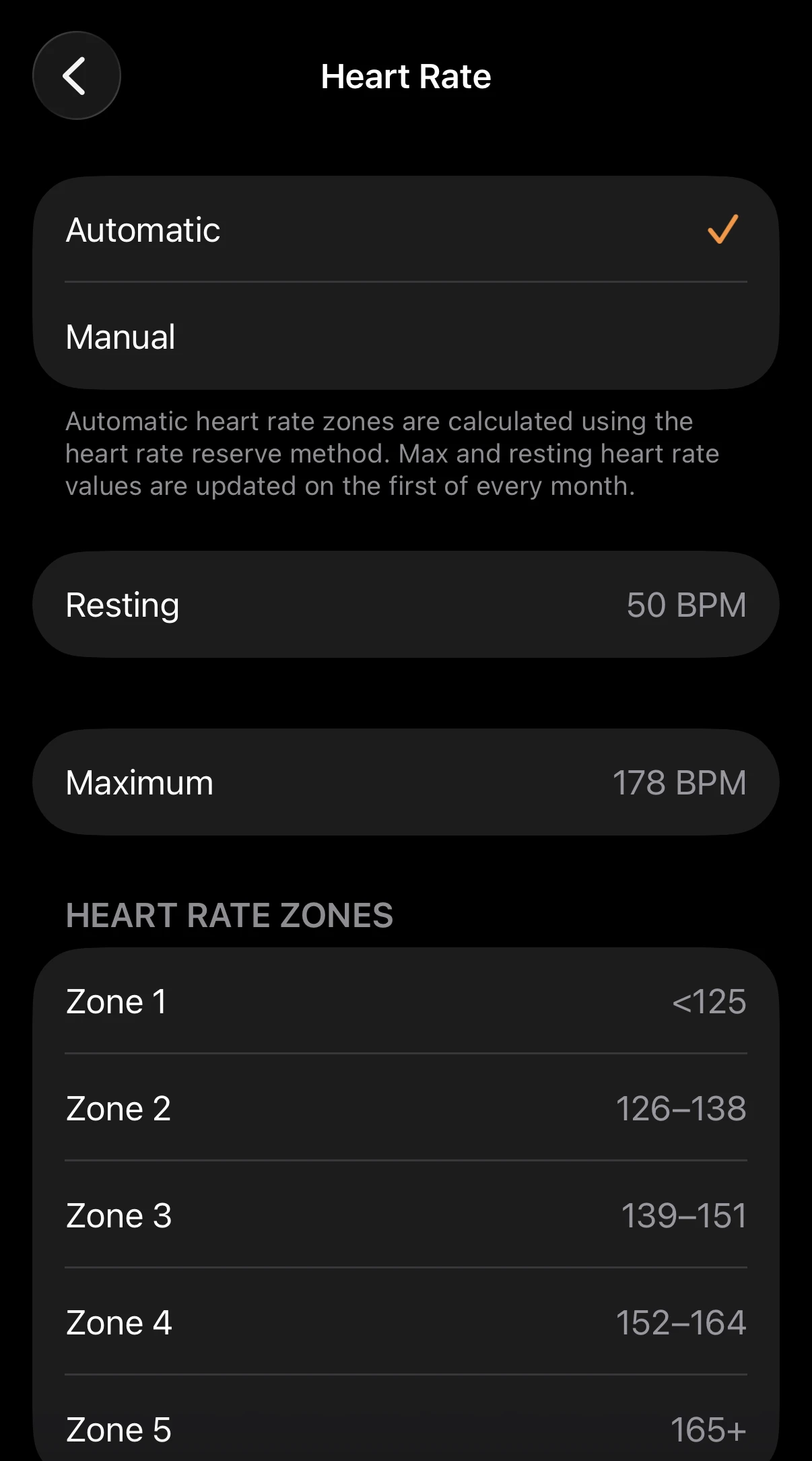
As shown in the official settings screen above:
- The System Note: Notice the fine print directly beneath the toggle: “Automatic heart rate zones are calculated using the heart rate reserve method. Max and resting heart rate values are updated on the first of every month.”
- Real-World Calibration: For this runner with a 50 BPM Resting HR and 178 BPM Maximum HR (an HRR dynamic reserve of 128 BPM), Apple Watch automatically calibrates Zone 2 to 126–138 bpm (roughly 60%–70% of HRR). If their resting heart rate rose to 70 BPM, their Zone 2 would immediately shift upward to 135–146 bpm.
- Monthly Recalibration: On the first day of every calendar month, Apple Watch recalculates your heart rate zones based on your recorded Resting Heart Rate (captured during sleep and morning resting periods) and estimated Maximum Heart Rate over the prior month.
- Where to inspect it:
- On your iPhone, open the Watch app.
- Navigate to Workout → Heart Rate Zones.
- You will see whether zones are set to Automatic (recommended) or Manual.
- What happens as your aerobic fitness builds:
- Over 6 to 12 months of consistent Zone 2 running, your resting heart rate will gradually trend downward (e.g., from 70 bpm down toward 50 bpm).
- Apple Watch will quietly recalibrate your Zone 2 window downward in absolute bpm.
- You might initially think: “Why did my watch lower my target?”
- But look at your pace: At that new, lower heart rate, your running pace will be 30 to 60 seconds per kilometer faster than when you started.
5. Summary: Stop Comparing Zone 2 BPM Across Runners#
| What People Assume | What Exercise Physiology Proves |
|---|---|
| “My Zone 2 ceiling is 154 bpm, so I have more aerobic capacity than my friend at 144 bpm.” | Your resting baseline is higher, so your zones are shifted upward from a higher floor. |
| “A lower resting heart rate restricts your Zone 2 window.” | A lower resting heart rate widens your Zone 2 window by expanding total Heart Rate Reserve. |
| “Zone 2 means everyone should run at ~135 bpm.” | Heart rate zones are personal ratios of your individual reserve, not universal numbers. |
The next time you see a runner with an envious 132 bpm Zone 2, don’t wonder why their number is lower. Look at how fast they are moving at that 132 bpm—and keep logging those easy miles to watch your own resting baseline drop.
Related Guides & Deep Dives#
- HRR vs %Max HR: Why You Can’t Run in Zone 2 (And How to Fix It) — How the traditional 220−Age formula breaks your easy runs.
- Heart Rate Zones Explained — The full 5-zone breakdown and metabolic thresholds.
- HRV and Recovery Monitoring — How your autonomic nervous system signals training readiness.
Frequently Asked Questions#
Why is my Zone 2 higher than my friend’s on Apple Watch?#
Because Apple Watch uses the Heart Rate Reserve (Karvonen) formula by default. If your resting heart rate is higher than your friend’s, your physiological baseline starts higher, which shifts your entire Zone 2 range upward in absolute beats per minute.
Does a lower resting heart rate make Zone 2 wider?#
Yes. Maximum heart rate is largely fixed by genetics and age. Lowering your resting heart rate expands your total Heart Rate Reserve (Max HR − Resting HR), which makes each individual training zone wider in bpm and easier to maintain during runs.
What should I do if my Apple Watch Zone 2 feels too difficult?#
Ensure your resting heart rate in Apple Health accurately reflects your true sleep/morning baseline, and verify that your recorded Maximum Heart Rate has not been artificially inflated by sensor cadence lock.