
Every runner eventually encounters the fundamental equation of running speed:
To run faster, you have only two mechanical levers: take more steps per minute, or cover more ground with each step.
Most runners begin by addressing cadence. They buy into the universal advice—bump your turnover to 175 to 180 spm to reduce joint impact and eliminate overstriding. That is sound advice, and for the first few months, it works wonders.
Then you hit the cadence ceiling.
Once your cadence is locked in at a rhythmic 178 or 180 spm, cranking it up to 190 or 195 spm on an easy aerobic run feels unnatural and frantic. The cardiovascular cost spikes simply from churning your legs faster.
If cadence is capped, the only remaining lever is stride length. Yet in the very next breath, coaches, podiatrists, and running apps issue a stern warning:
“Never overstride. Overstriding causes braking forces, shin splints, and knee injuries.”
This creates the central paradox of endurance mechanics: If you aren’t allowed to overstride, how are you supposed to lengthen your stride?
The answer lies in where that stride length actually happens.
1. Frontside Reaching vs. Backside Extension#
The confusion stems from a fundamental misunderstanding of what “stride length” means in physics versus what it looks like to the human eye.
When runners try to consciously “lengthen their stride,” they usually reach their lead foot forward. They extend the knee, stretch the leg out in front of the body, and land far ahead of their hips.
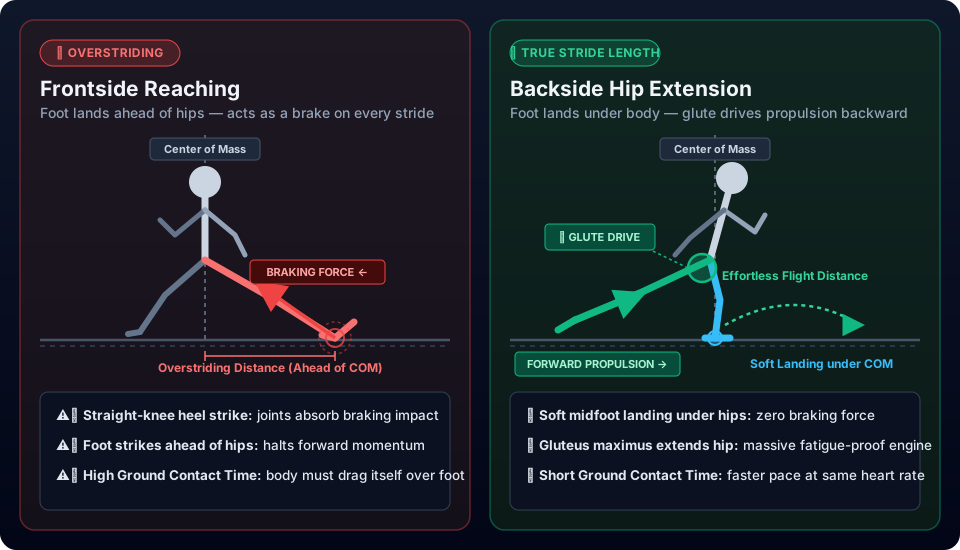
The Physics of Overstriding (Frontside Reaching)#
- Where the foot lands: Ahead of your Center of Mass (COM).
- Ground Reaction Force: When your heel strikes the road in front of your body, the vector points backward against your momentum.
- The mechanical result: You are slamming on the brakes with every single step. Your quads, knees, and shins absorb the deceleration shock, Ground Contact Time (GCT) increases, and you must burn extra energy just to pull your body back over your foot.
The Physics of Natural Stride Length (Backside Extension)#
- Where the foot lands: Directly beneath or marginally ahead of your Center of Mass.
- Where the distance comes from: True stride length is flight distance, not reaching distance. It is determined by how much propulsive force you drive into the road during push-off, propelling your body forward through the air before the next contact.
- The mechanical result: The foot meets the ground softly with zero braking force. As your center of mass rolls forward, the hip extends behind you. The hip extensor muscles drive backward, launching you into an effortless, floating flight phase.
Stride length is not about how far forward you reach with your foot. It is about how far your body travels through the air because of the force you pushed behind you.
2. The Engine Room: Why the Gluteus Maximus Matters#
To achieve powerful backside hip extension, your body needs a prime mover capable of generating backward force against the road without fatiguing.
That muscle is the gluteus maximus.
The gluteus maximus is the largest and heaviest muscle in the human body. From an evolutionary perspective, human glutes evolved to their massive size specifically for bipedal endurance running. Unlike the calves and hamstrings, the gluteus maximus is packed with fatigue-resistant motor units designed to absorb ground forces and extend the hip repeatedly for hours.
The Problem: Glute Amnesia#
In modern life, most runners spend eight to ten hours a day sitting in desk chairs, cars, and on couches.
Prolonged sitting keeps the hip flexors (iliopsoas and rectus femoris) in a chronically shortened, tight position. Through a neurological phenomenon called reciprocal inhibition, hyperactive, tight hip flexors signal the opposing muscles—the glutes—to dial down their activation.
When runners with inactive glutes lace up their shoes, the body still has to move forward, so it compensates:
- The Calves Take Over: The smaller calf muscles (gastrocnemius and soleus) try to produce propulsion through excessive ankle push-off.
- The Quads Take Over: The quadriceps pull the runner forward from the front rather than pushing from behind.
- The Stride Collapses: Because calves and quads are small and fatigue quickly, they run out of steam after 10 to 15 kilometers.
This creates the classic “late-run shuffle”: on the final 5K of a half marathon or weekend long run, your cadence might stay high at 180 spm, but your stride length collapses from 0.95m down to 0.80m. You feel like you are working twice as hard to run significantly slower.
3. What Glute-Driven Running Looks Like in the Data#
When you successfully wake up the posterior chain, the biomechanical adaptation shows up clearly across your running metrics:
| Metric | Quad / Calf Dominant (Glutes Asleep) | Glute-Driven (Hip Extension Active) | Why the Difference Occurs |
|---|---|---|---|
| Cadence | 176 – 182 spm | 176 – 182 spm | Turnover stays rhythmic; cadence does not need to spike. |
| Stride Length | 0.85 – 0.92 m (collapses late) | 0.98 – 1.05 m (holds steady) | Backside push-off naturally lengthens flight distance without overstriding. |
| Ground Contact Time | > 250 ms | < 235 ms | Elastic recoil from the glute and hip joint snaps the foot off the ground faster. |
| Pace at Same Heart Rate | e.g. 6:10 / km at 140 bpm | e.g. 5:45 / km at 140 bpm | Larger, fatigue-resistant muscles do the work; cardiovascular strain drops. |
| Vertical Oscillation | High (> 9.5 cm) | Compact (7.0 – 8.5 cm) | Force is directed horizontally forward rather than bouncing straight up. |
Notice the critical observation in the table: cadence barely changes.
You do not run faster by churning your legs in a panic. You run faster because each single contact sends you 8 to 12 centimeters further down the road, while your foot still lands cleanly underneath your body.
4. Three Practical Mental Cues on the Run#
You cannot consciously control individual muscle fibers during a run, especially when turning your legs over three times every second. Instead, use external movement cues to let your nervous system recruit the glutes naturally:
Cue 1: “Push the road away behind you”#
Do not think about reaching forward for the next step. Focus entirely on the push-off phase of the trailing leg. Imagine you are standing on a skateboard or a treadmill belt, and your job is to sweep the surface backward behind your pelvis.
Cue 2: “Run tall from the belt buckle”#
If your pelvis dumps forward into an anterior tilt (arched lower back, sticking your stomach out), your hip joint physically locks up and cannot extend backward. Keep your pelvis neutral—imagine your belt buckle is level with the horizon. A neutral pelvis frees up the hip joint to swing fully behind you.
Cue 3: “Land under the hips, not in front of your eyes”#
Keep your knee slightly soft on landing, allowing your foot to meet the pavement directly below your torso. Let the ground come to you rather than reaching out to meet it.
5. The 10-Minute Off-Feet Fix (No Gym Required)#
If your glutes have been dormant for months, mental cues alone are rarely enough. The nervous system needs targeted neuromuscular activation before it will reliably recruit the gluteus maximus at 180 steps per minute.
You do not need a commercial gym or heavy barbell squats. Ten minutes of focused bodyweight and light resistance movements, performed 2 to 3 times a week, is enough to re-establish the connection.
1. Single-Leg Glute Bridge#
- Why it matters: Isolates pure hip extension without allowing the lumbar spine or quads to take over.
- Execution: Lie on your back, knees bent, feet flat. Lift one leg off the floor. Driving through the heel of the planted foot, squeeze your glute to lift your hips until your knee, hip, and shoulder form a straight line. Hold at the top for 2 seconds.
- Target: 3 sets of 10 to 12 reps per side.
2. Bulgarian Split Squat (Rear-Foot Elevated)#
- Why it matters: Simultaneously stretches the hip flexor of the back leg (releasing the brake) while loading the glute of the lead leg under full body weight.
- Execution: Place the top of one foot on a chair or bench behind you. Lower into a lunge until your front thigh is nearly parallel to the floor, leaning your torso slightly forward to bias the glute. Drive back up through the front heel.
- Target: 3 sets of 8 to 10 reps per side.
3. Single-Leg Romanian Deadlift (RDL)#
- Why it matters: Trains the glute and hamstring to stabilize the pelvis on one leg, mirroring the exact single-leg stance phase of running.
- Execution: Stand on one foot with a soft knee. Hinge at the hip, sending your other leg straight back behind you like a counterweight while keeping your back flat. Squeeze your standing glute to return to an upright posture.
- Target: 3 sets of 8 to 10 reps per side.
⏱️ Interactive Tool: Run through these movements with automated work, rest, and exercise transition cues using our free Runner Strength & Core Timer.
Summary: The Efficient Runner’s Checklist#
- Cadence sets the rhythm, but stride length sets the ceiling. Once your cadence is in the 175–182 spm pocket, stop trying to churn faster.
- Overstriding happens in front; stride length happens behind. Never reach forward with the foot. Drive backward through hip extension.
- Wake up the glutes off the road. Tight hip flexors shut down glute recruitment. Use simple single-leg bridges and split squats between run days to re-educate your nervous system.
- Track the result in your data. Use Running Form Metrics to watch your stride length expand while your ground contact time drops and your heart rate stays locked in Zone 2.
Scientific References & Further Reading#
- Lieberman, D. E., Raichlen, D. A., Pontzer, H., Bramble, D. M., & Cutright-Smith, E. (2006). “The human gluteus maximus and its role in running.” Journal of Experimental Biology, 209(11), 2143–2155. PMID: 16709916
- Heiderscheit, B. C., Chumanov, E. S., Michalski, M. P., Wille, C. M., & Ryan, M. B. (2011). “Effects of step rate manipulation on joint mechanics during running.” Medicine & Science in Sports & Exercise, 43(2), 296–302. PMID: 20581720
- Dorn, T. W., Schache, A. G., & Pandy, M. G. (2012). “Muscular strategy shift in human running: dependence of running speed on hip and ankle muscle performance.” Journal of Experimental Biology, 215(11), 1944–1956. PMID: 22573774
- Schache, A. G., Dorn, T. W., Williams, G. P., Brown, N. A., & Pandy, M. G. (2014). “Lower-limb muscular strategies for increasing running speed.” Journal of Orthopaedic & Sports Physical Therapy, 44(10), 813–824. PMID: 25103134
- Powers, C. M. (2010). “The influence of abnormal hip mechanics on knee injury: A biomechanical perspective.” Journal of Orthopaedic & Sports Physical Therapy, 40(2), 42–51. PMID: 20118526
- Bramble, D. M., & Lieberman, D. E. (2004). “Endurance running and the evolution of the genus Homo.” Nature, 432(7015), 345–352. PMID: 15549097