
See how your week is adding up
Wednesday night, and the question is always the same: is that enough, or do I need a longer one at the weekend? Adding up four runs in your head is a bad way to answer it.
Your week so far, totalled and drawn, without you adding anything up. It sits on the Summary tab under Weekly Stats.
The card is free and there’s nothing to switch on. One card further down, Pro adds an effort split of the same week.
What you’re looking at#
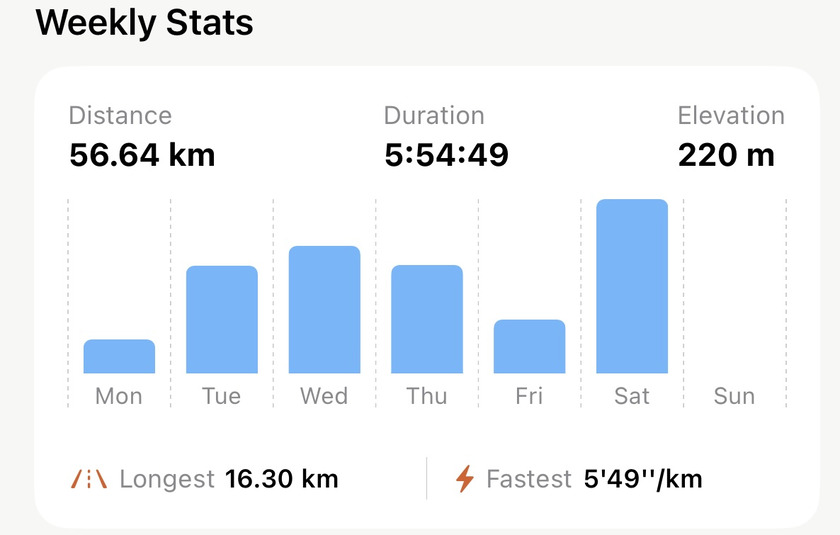
- Distance, Duration, Elevation — the week’s three totals. Elevation is climbing only, so a flat week reads low no matter how far you went.
- A bar for each day, sized by the distance you ran that day. Two runs on one day stack into one bar.
- Longest and Fastest — the week’s standout runs, by distance and by pace.
The bars have no scale, on purpose. There are no numbers up the side, so don’t read a bar’s height as a figure — read the bars against each other. What you’re looking for is the shape: one tall bar and five short ones is a different week from six middling ones, even when the totals match.
Three things here are tappable, and they don’t look it#
This is the part people miss for months.
- Tap the totals or the chart and you get the full Stats screen — the same numbers over months and years instead of one week.
- Tap Longest and it opens that run.
- Tap Fastest and it opens that run.
So the card is also the quickest route to that run — the one you’re thinking of but can’t date. You don’t have to scroll your history to find Saturday’s long one; it’s already named at the bottom of the card.
When the week resets#
It’s a calendar week, not the last seven days. The totals run from the first day of your week up to now, so they empty out on your week’s first morning and build back up. A small number on Monday isn’t a bad week — it’s a new one.
Which day that is, is yours to set. Monday or Sunday, from Profile→Settings→Week Starts On — change it and this card recounts straight away. Worth getting right if your long run lands on a Sunday, because it decides whether that run closes one week or opens the next.
Intensity Distribution, if you have Pro#
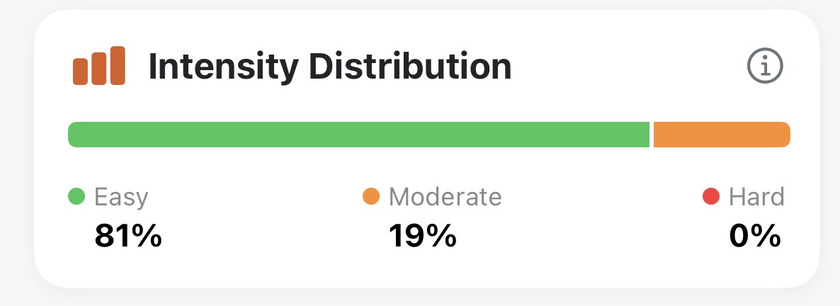
One card further down, Pro adds the week’s effort split: Easy, Moderate and Hard, read from your heart rate zones.
These are percentages of time, not of runs. That’s what makes the card honest — a twenty-minute interval session is a small slice of a six-hour week, however hard it felt, and the bar shows it that way.
Most well-built weeks sit somewhere near 80% easy. The 81/19/0 above is a base week doing its job, and the useful reading is the direction: if Easy keeps sliding down week to week without you planning it, your easy days have crept up to moderate.
Worth knowing#
- The 7-Day Load on the card above is a different number, on purpose. Training Status counts back seven days from today, so it can still be carrying last Sunday’s long run; this card starts at your week’s first day and doesn’t. Same runs, two questions.
- A week with no runs yet replaces the footer with First run of the week awaits! — the card is waiting, not empty.
- Treadmill runs count in the distance, the duration and the bars. They just add nothing to the elevation total.
- Fastest means the best average pace across a whole run, so it’s usually a short one. It isn’t your quickest kilometre — that’s a best effort, and it lives on the run itself.
Get the app
Your week, already counted.
Weekly Stats is free and builds itself from runs you've already imported — nothing to set up. Look at the bars before the totals: the shape of the week tells you more than the sum of it.
↓ Download Apex Run