
Know how far each pair has actually run
Two pairs in the rotation, both bought last spring, and no way of telling which one has the miles on it. Your runs already know. They just need telling which shoes you wore.
Add each pair once, say which one you wore, and Apex Run keeps the total. It’s the difference between these feel a bit flat and these have done 740 km.
Where it is#
Profile→Settings→Shoes Tracker , in the same group as Run List Display.
There’s a shortcut worth knowing: the ⓘ beside Shoes in any run’s edit sheet opens this screen too, so you can add a pair in the middle of tagging a run.
Adding a pair#
Tap + top right. There are two fields and neither is fussy:
- Name — whatever you call them out loud. Pegasus 41, the blue ones, trail shoes.
- Purchase Date — shown on the row as Added, and the date the offer below counts from.
The list sorts by name, so if you run a rotation it’s worth naming with that in mind: Road — Pegasus, Road — Endorphin, Trail — Speedgoat keeps like with like, where Pegasus, Endorphin, Speedgoat scatters them.
The one offer you get, and it only comes once#
Save a new pair and, if you have runs since its purchase date with no shoes on them, Apex Run asks:
Tag past runs? Your runs since 8 Sep 2026 that don’t have shoes yet can all be tagged with “ASICS NOOSA TRI 16 RED”. You can change any of them later. Not Now · Tag 43 Runs
Take it and that pair starts with a real number instead of 0.00. It’s the difference between a tracker that’s useful tonight and one that’s useful in six months.
Two things make it safe to say yes to:
- The button counts first. You see how many runs it’s about to touch before you tap, so a purchase date you got wrong announces itself as an implausible number.
- It never takes a run off another pair. Only runs with no shoes are claimed, so adding a second pair can’t quietly move the first pair’s mileage across. If everything since that date is already tagged, you aren’t asked at all.
A rotation is the case to decline. If you alternate two pairs, no date can tell them apart, and the count will look far too big. Tap Not Now and tag as you go.
What a row tells you#
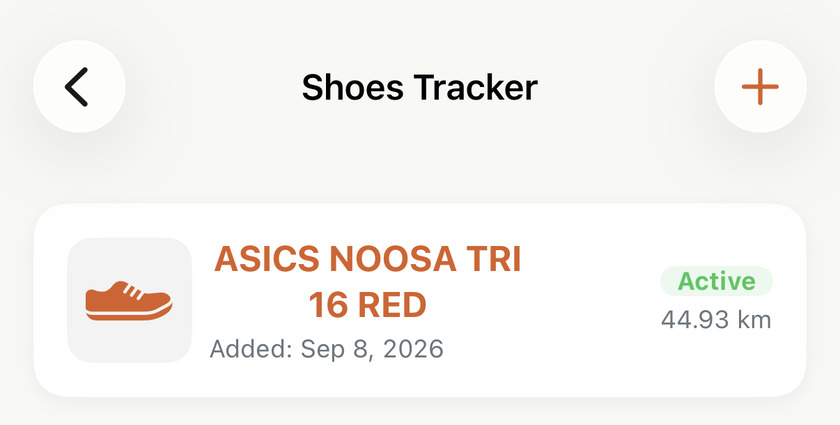
Each pair carries its name, the date you added it, an Active or Retired badge, and the distance it has run.
That distance is the whole point of the screen, and it comes from one place: the runs you’ve tagged with that pair. Apex Run can’t see your feet, so a pair you never tag stays on 0 km however much you wear it.
Tagging is the part you have to do#
Open a run, tap the edit button, and pick the pair under Shoes — that’s it, and it’s covered properly in names, notes, favourites and shoes.
Two things follow from tagging being the source:
- A new pair starts honest. Add it today, tag from today, and the total is right from the first run.
- The past stays open. Tagging an old run adds its distance whenever you do it, so a pair you didn’t back-fill at the start can still be brought up to its real total one run at a time.
Move a run to a different pair and the distance moves with it. Untag it, or delete the run, and it comes off.
Retired is a label, not a switch#
The Status picker on a pair — Active or Retired — changes the badge on the row and nothing else.
A retired pair is still in the Shoes list on every run, and still adds up anything you tag to it. So use it for what it’s good at: marking that a pair is done, so next spring you can tell which of the three Pegasuses in your cupboard is the live one. Don’t expect it to tidy the picker.
Nothing tells you when to replace them#
There’s no threshold, no warning and no colour change at a magic number — the total is reported and the judgement is yours.
For what it’s worth, road shoes are usually quoted at 500–800 km, and that’s a range rather than a rule: heavier runners, rougher surfaces and thin racing shoes all land nearer the bottom of it. What the tracker gives you isn’t the answer, it’s the one thing you can’t get any other way — knowing where a pair actually is.
Worth knowing#
- Deleting a pair doesn’t touch your runs. The pair goes, and the runs that wore it simply stop naming shoes. Every kilometre they ran is still theirs.
- The delete has no undo, and the total is gone with the pair — but you can add it again and re-tag the runs, because the distance was never stored on the shoes in the first place.
- It’s all on this phone. Shoes aren’t part of your Apple Health data, so another device shows an empty list even with the same runs imported.
- A pair’s total updates itself. Tag a run now and the number is right the next time you open this screen — there’s nothing to refresh.
Get the app
Add the pair you're wearing tonight.
Shoes Tracker is free and takes about twenty seconds to set up. Add the pair you run in most, tag it on tonight's run, and the total starts keeping itself.
↓ Download Apex Run