
Race your old self on your usual loopFree + Pro
A pace is only a verdict if the route behind it is the same. Apex Run works out when you've run this loop before, tells you how today stacked up against your best on it, and — with Pro — ranks every attempt you've ever made.
Your watch tells you today’s average pace. What it can’t tell you is whether 6'09’’ was good, because 6'09’’ on a flat riverside loop and 6'09’’ up a hill are different runs. The only fair comparison is the same route — and you’ve probably run yours dozens of times.
Apex Run spots the loop for you#
There’s nothing to set up and no course to define. When a run finishes importing, Apex Run checks it against everything else in your library and decides whether you’ve been here before. To count as the same route, two runs have to agree on all of this:
- Distance within 5% of each other.
- Start and finish within about 150 m. Close enough that a different spot on the same street still counts.
- The middle has to line up too — three checkpoints along the way, each within the same 150 m. Two runs that leave from your door and come back to it, but go opposite directions in between, are not the same route.
A route needs GPS, so a treadmill run never gets a Shadow Runner card. And because the check runs against your whole library, routes you ran long before you installed Apex Run are already grouped.
What the card tells you#
Open any run and scroll to Shadow Runner, just under Best Effort:
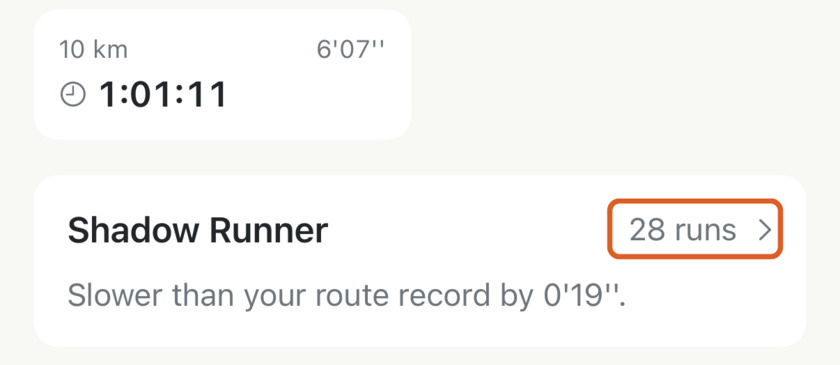
The count is how many times you’ve run this route, today included — so a 1 never appears; the card only shows up when there’s something to compare against. Under it, one of three verdicts:
- Route Record! — you beat your best on this route, and by how much. Shown in orange, because it’s the one you want.
- Slower than your route record by x — the gap to your best, per kilometre.
- Tied your route record! — within a second per kilometre either way. Close enough that Apex Run won’t pretend to split it.
The gap is a pace difference, not a time difference. Nineteen seconds per kilometre over a 13 km loop is about four minutes of finish time, which is why this reads harsher than it feels.
Pro: the whole leaderboard#
Tap the card and every run on the route comes up, ranked fastest first:
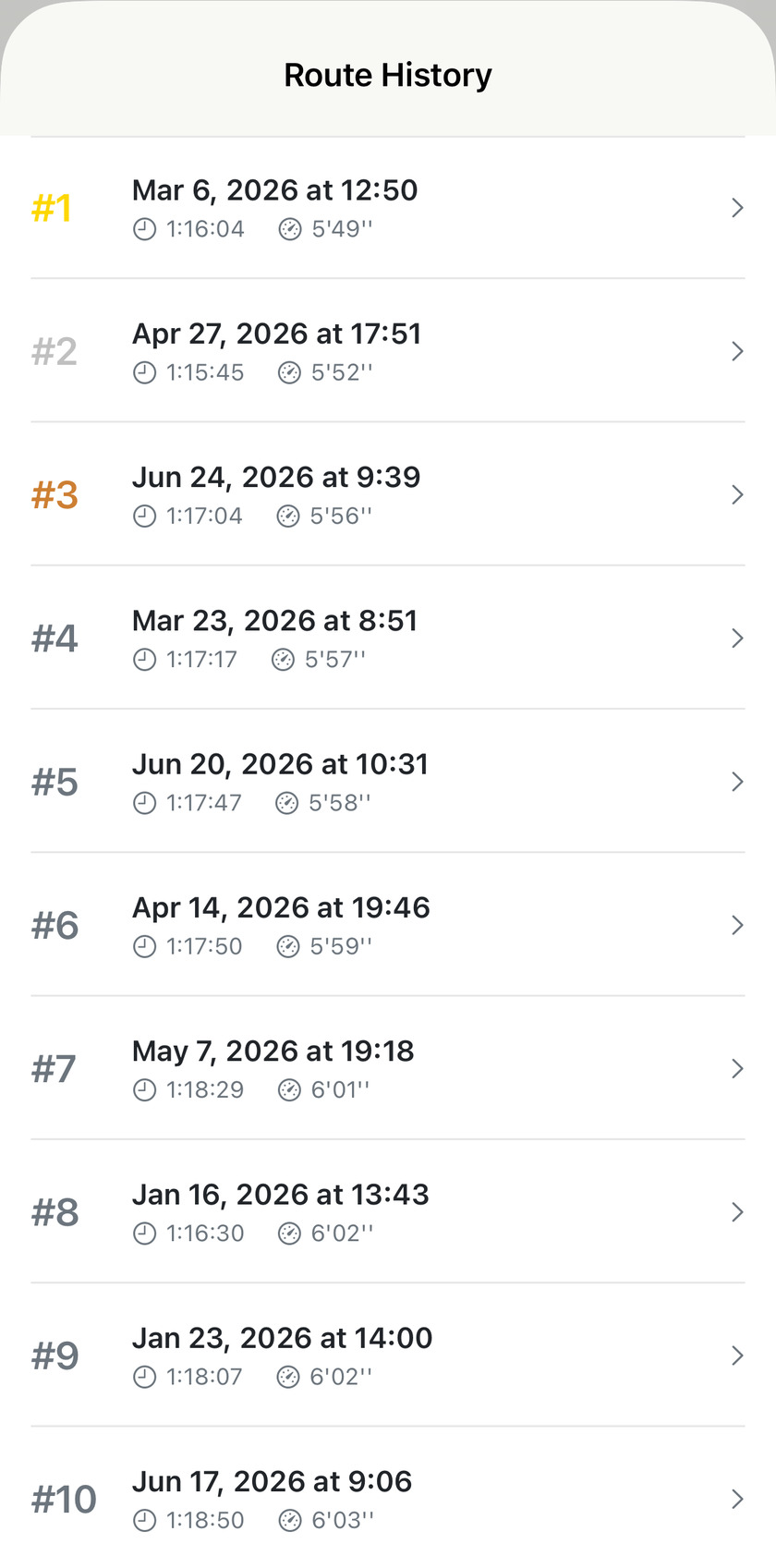
- Ranked on average pace, not finish time — which is why #1 above sits ahead of #2 despite taking nineteen seconds longer. Its route was slightly longer, and pace is what makes two attempts comparable.
- The run you came from is highlighted in orange wherever it lands, which is how you find yourself in a list of thirty. It isn’t in the ten above — at 6'09’’ that run placed below #10, and you’d find it after Show all.
- Ten rows to start, then Show all n runs for the rest.
- Every other row opens that run. Handy when your #1 was months ago and you want to know what you did differently — what your heart rate was doing, what the weather was.
Every card is frozen in time#
This is the part worth understanding, because it looks like a bug the first time you see it.
Shadow Runner only ever counts runs recorded before the one you’re looking at. Open this morning’s run and you get the full 28. Open a run from January and you get the four you’d done by January — and it’s judged against your best at that point, not your best now.
That’s deliberate, and it makes the card mean something: a Route Record! from March stays a route record forever, instead of quietly demoting itself the next time you have a good day. Your run detail screens read like a log of what happened, not a scoreboard that rewrites itself.
Getting something out of it#
- It rewards having a usual loop. If every run starts somewhere different, nothing clusters and no cards appear. One route you come back to every couple of weeks is worth more than ten you ran once.
- Compare the conditions, not just the number. Tap into your #1 before deciding you’ve lost fitness. A route record set on a cool October evening isn’t the benchmark for a humid August lunchtime.
- A record on an easy run means you weren’t running easy. If your loop keeps producing records on days you meant to jog, that’s worth noticing — this card is a decent accidental check on whether your easy days are actually easy.
Get the app
Find out if your loop is actually getting faster.
Shadow Runner reads the runs already in your library, so the ranking is there the first time you open a route you've run before. The full Route History is part of Pro, with a 14-day trial.
↓ Download Apex Run