
Read your running form on any runFree + Pro
Fitness takes months to move. Form can change on the next run. The Running Dynamics section is where you see what your legs actually did — how often they landed, how long they stayed down, how much of the effort went up instead of forward.
Every other section on a run is about the run. This one is about you. Pace and heart rate tell you how hard it was; the six numbers under Running Dynamics tell you how your body went about it, and they are the part of running you can change without adding a single kilometre.
Where to find it#
Scroll past the metric cards and it’s the section just before the splits. It appears on any run your watch recorded steps for, which is nearly all of them, and it shows only the tiles the run has data for.
What you’re looking at#
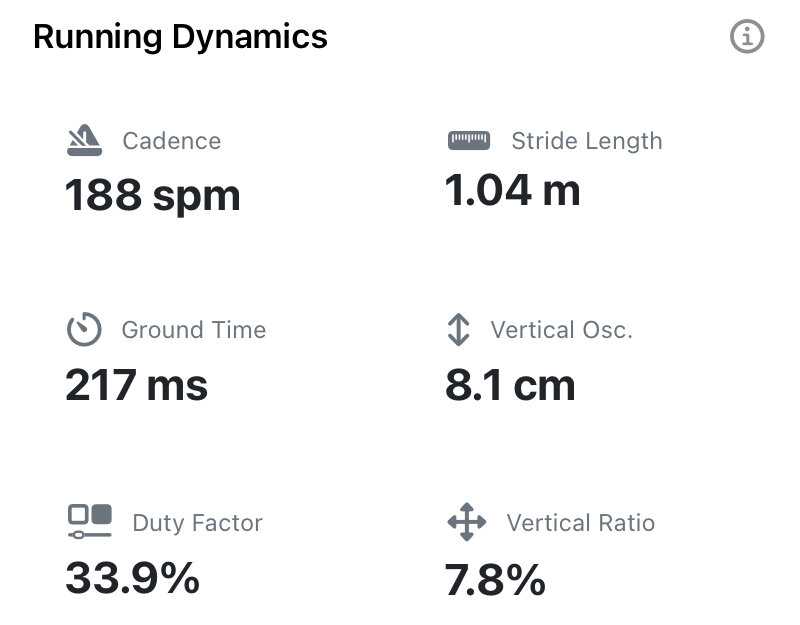
Two tiles to a row, in this order:
- Cadence — steps per minute, both feet. The number most runners already know.
- Stride Length — the ground each step covered. Cadence times stride is your speed, so these two are the whole of pace between them, and the trade-off between them is most of what “form” means.
- Ground Time — how long each foot stayed on the ground, in milliseconds. Shorter as you run faster.
- Vertical Osc. — how far your centre of mass bounced each step, in centimetres. Bounce is effort that didn’t move you forward.
- Duty Factor (Pro) — the share of each stride spent on the ground rather than in the air.
- Vertical Ratio (Pro) — bounce as a share of stride length. Of the six, this is the one that most directly says how much of each stride was wasted going up.
With Pro the section is three rows. Without it, the section is the top two rows and the last two tiles simply aren’t there.
Reading it#
All six move with pace, so a number only means something against another run at a similar pace. Ground time gets shorter and stride gets longer as you speed up, on everyone; a tempo run and a recovery run will never agree, and shouldn’t. The useful comparisons are:
- The same kind of run, a few months apart. A stride that has lengthened at the same cadence and the same pace is a real change. So is a vertical ratio that has come down.
- Two halves of a hard run. Open the splits and watch how ground time and cadence held up late on — or didn’t. Form fading is one of the earliest signs of a run that was longer than you were ready for.
- Before and after a change. New shoes, a cadence you’ve been working on with the metronome, a stretch of hill work. This section is where you find out whether it took.
The two Pro ratios are the shortcut. Each is built from two of the free tiles, and each removes pace from the picture a little: a shorter ground time at a faster pace is expected, but a lower duty factor at the same pace is you. The Learn page goes through what typical values look like; the numbers on your own runs, compared with each other, are the better guide.
When a tile is missing#
- Treadmill run — cadence and stride length only. The watch doesn’t measure ground time or bounce indoors, and stride is worked out from distance and steps instead.
- An older watch — ground time and vertical oscillation need a watch from the last few generations. Cadence and stride are there on any watch.
- No watch at all — a phone-only run has no section, because nothing counted the steps.
- Two Pro tiles gone — duty factor needs ground time, vertical ratio needs oscillation. A run without the ingredient has no ratio, Pro or not.
Worth knowing#
- The four measured tiles are free, on every run, however old. Pro’s part is the two ratios.
- The ⓘ beside the heading explains each metric in the app’s own words, if you’d rather read it on the run.
- Cadence here is the run’s average. The metronome is where you set a target for the next one.
The metric behind it: Running form metrics explained
Get the app
See where the effort went.
Cadence, stride, ground time and bounce on every watch run, free. Pro adds the two ratios that say how much of each stride was wasted.
↓ Download Apex Run