
Know whether to push or hold back, before you lace up
You already know the feeling of starting a hard session your body hadn't agreed to. Recovery gives you a read on that before you're out the door, measured against your own normal rather than a population average.
Most readiness scores hand you a number out of 100 and no way to check its work. This one gives you a word and then shows you every measurement it used, next to your own thirty-day range, so you can disagree with it.
The four states#
- Optimal — fully recovered and ready. A prime day for a key session: intervals, tempo, or a race-pace simulation.
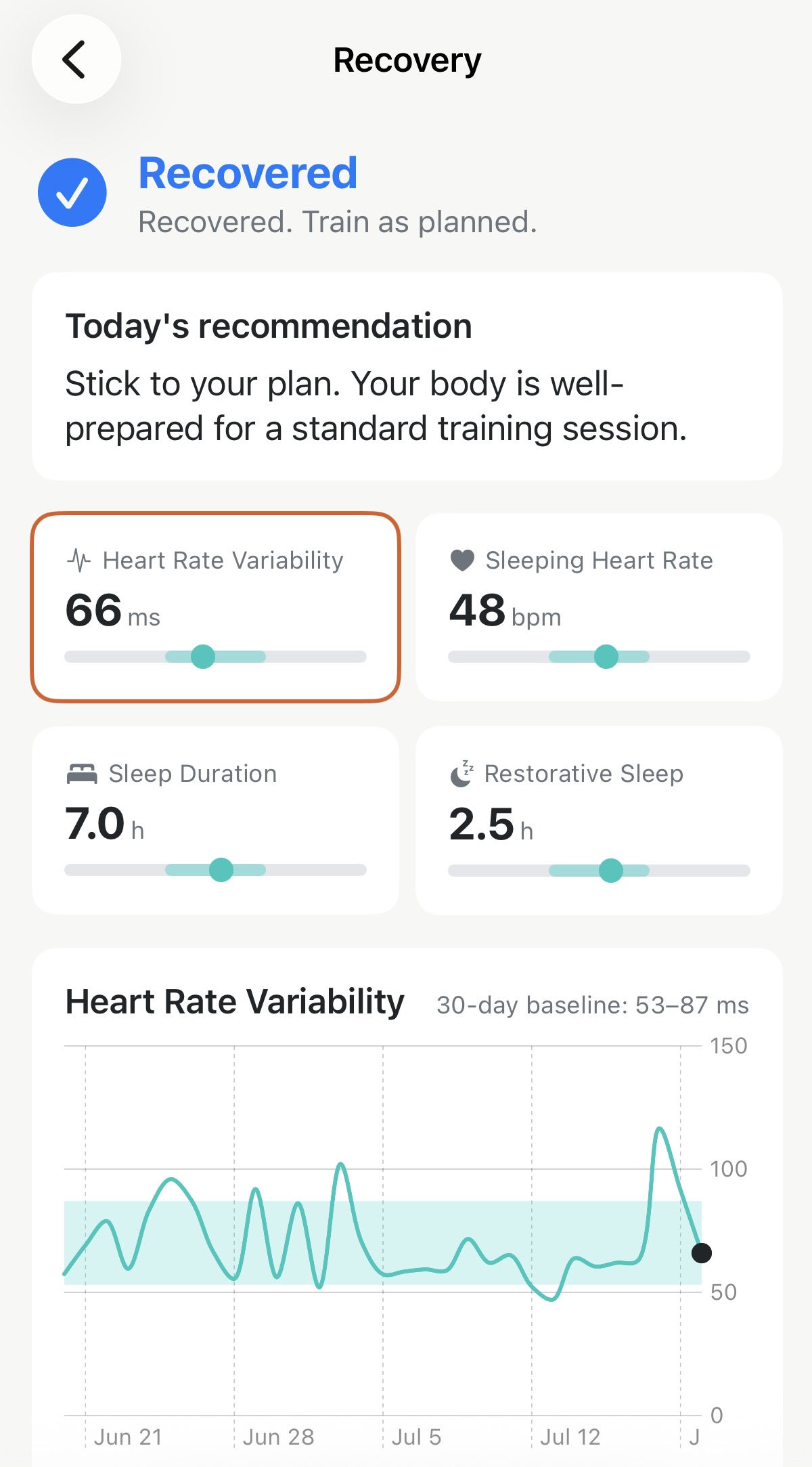
- Recovered — train as planned. Your body is prepared for a standard session; stick to your plan.
- Compromised — partially recovered. Keep the intensity low and hold today to an easy Zone 2 run.
- Fatigued — under-recovered. Prioritise rest or active recovery: a very light jog, or gentle movement.
The state is free. The sentence spelling out what to do with it — Today’s Guidance — is the Pro half.
The numbers behind it#
Every metric is shown against your 30-day baseline, with a trend you can tap into. How to read those bars and bands has its own page.
- Heart Rate Variability — beat-to-beat variation in your heart rate. Higher usually means better recovered.
- Sleeping Heart Rate — your heart rate while asleep. Lower usually means better recovered.
- Sleep Duration — total time asleep.
- Restorative Sleep — deep plus REM, the stages that do the most repair.
Two more readings, Respiratory Rate and Blood Oxygen, sit under Reference: shown for you to notice, not scored.
When it has nothing to go on#
Recovery needs an Apple Watch worn during sleep. If you left it on the nightstand, you’ll get told so — “No sleep data last night” — rather than handed a verdict built on a stray reading.
That distinction matters more than it sounds. A night with no sleep data is not a night of no sleep, and scoring it as one would have greeted you with Fatigued on a morning you actually slept nine hours. Recovery waits for tonight instead.
How to actually use it#
- Read it before you decide, not after you’ve decided. The value is in changing today’s session, and that decision has usually hardened by the time you’re warmed up.
- Don’t chase Optimal. Training makes you tired; a block of hard weeks should show Compromised mornings. Two or three Fatigued days in a row is the signal worth acting on, not a single one.
- Treat it as one input. If it says Compromised and you feel excellent, you’re allowed to run. It’s showing you what last night looked like, not issuing instructions.
The metric behind it: HRV and recovery
Why it was built this way: Building the morning recovery check
Get the app
Get tomorrow morning's read.
Wear your watch tonight, open Apex Run in the morning, and you'll have a recovery state plus every number behind it. The state and its metrics are free.
↓ Download Apex Run