
Read a recovery number against your own baseline
The number on the card is only half of it. The bar underneath is the other half, and it's the half that says whether this morning is normal for you.
Population averages are how most readiness apps tell a 25-year-old and a 55-year-old the same thing. Your HRV is yours; what matters is where this morning sits against your own recent nights. That’s what every bar and band on the Recovery screen is drawing.
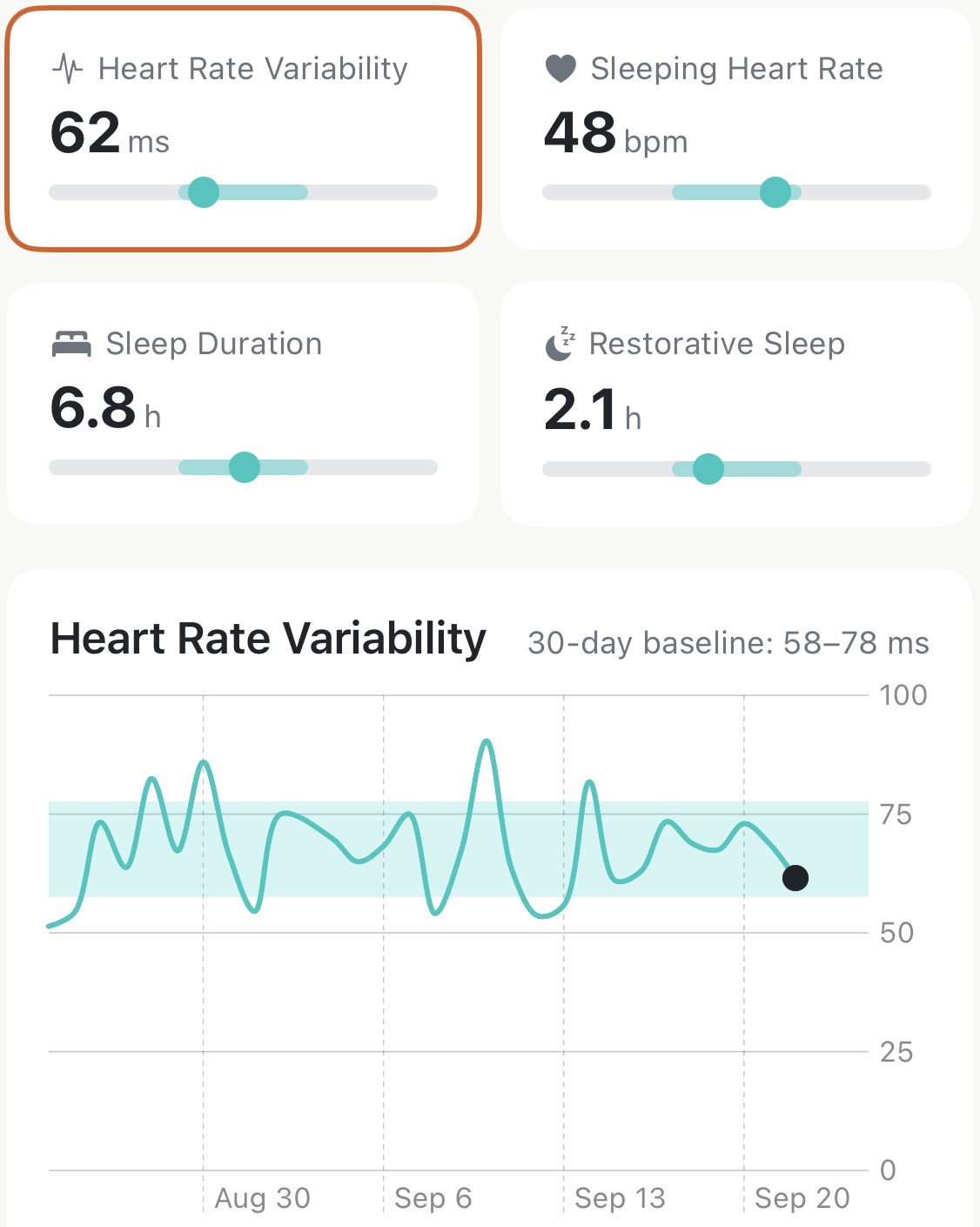
The band is your last 30 nights#
Each metric’s baseline is the average of your last 30 nights, not counting today, with a band one standard deviation either side. In plain terms, the band is where roughly two nights in three have landed lately. Inside it is normal for you. Outside it is the signal.
Two things follow from how it’s built:
- It needs a week before it says anything. With fewer than seven nights on record, the card reads Building your baseline and counts them. Wear the watch to bed for a week and the numbers start meaning something; give it the full month and they mean more.
- It moves with you. A block of hard training lowers your HRV band a little over the weeks; a taper raises it. You’re always compared with the recent you, which is the comparison that matters for today’s decision.
The bar under each number#
The dot is today. The shaded stretch is the band. That’s the whole reading:
- Dot inside the band: a normal morning for you, whatever the absolute number.
- Dot past the right end of the HRV bar: higher than usual, which for HRV is the good direction.
- Dot past the right end of the Sleeping Heart Rate bar: higher than usual, which for sleeping heart rate is the bad direction. The bars read the same way; the metrics don’t, and the one-line description under each chart says which way is good.
Tap a card for its 30 days#
Tapping any of the four cards switches the chart beneath to that metric. The band is shaded across the whole month so you can see when you left it and for how long, and today is the black dot at the right end.
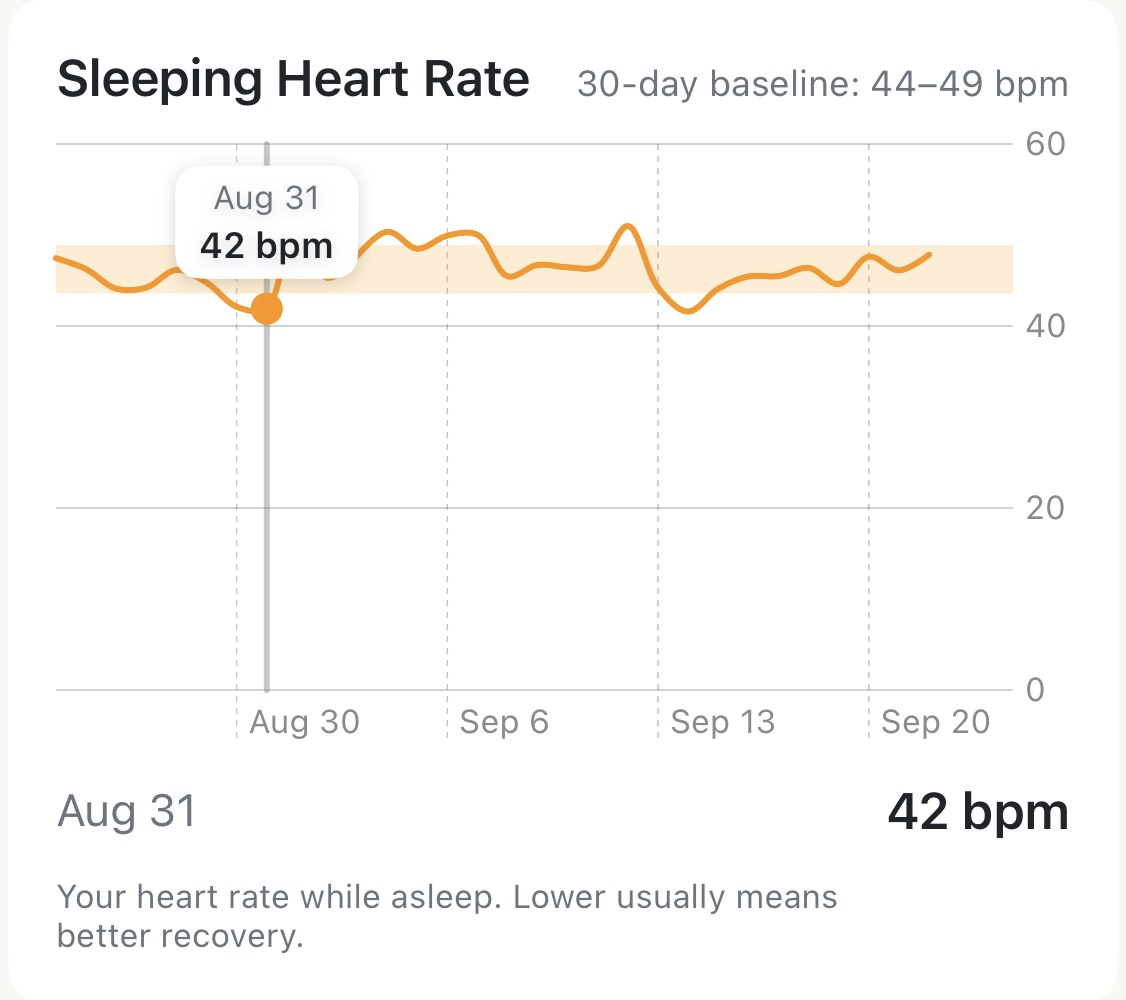
Drag your finger along the chart to read a single night. The label below it changes from Today to that date.
How four numbers become one word#
The morning state is worked out from the same bars you can see, in a fixed order, so you can always check its work:
- HRV sets the starting point. Above your band is Optimal, inside it is Recovered, below it is Compromised, and far below, two bands’ width under your average, is Fatigued. No HRV reading, no verdict.
- A raised sleeping heart rate knocks it down one step. A sleeping heart rate above your band is a stress signal, from a hard day, a late meal, a drink or a cold coming on. It can only lower the state, never raise it.
- A short night caps it. Under four hours, or well under your own usual, and the best you can get is Compromised. Short night and HRV below the band is Fatigued.
Restorative Sleep is shown, not scored. Deep plus REM is worth watching on its own, and it’s on a card with its own band and chart, but it doesn’t feed the verdict. Nor do the two Reference readings, respiratory rate and blood oxygen, which have no band and no chart; they’re there because a rising respiratory rate or a falling oxygen level is worth noticing before you feel it.
Worth knowing#
- Sleeping heart rate is your lowest stretch of the night, roughly the calmest fifth of it, so one dream or a trip to the bathroom doesn’t raise it.
- Two sleep sources don’t double-count. A night recorded by both the watch and a sleep app is scored from whichever covered more of it.
- A night with no data isn’t a bad night. It leaves a gap in the chart and the band is built from the nights around it; it never counts as zero. Why that matters is on the states page.
- Don’t chase the band’s right end. A run of mornings above your HRV band usually means you’ve been resting, not that you’ve become fitter. The band will catch up, and Recovered will be the new normal.
The metric behind it: HRV and recovery
Why it was built this way: Building the morning recovery check
Get the app
Your normal, not a population's.
After a week of nights with the watch on, every recovery metric is read against your own range. Free, and the same screen shows how the morning verdict was reached.
↓ Download Apex Run