
Tell a slow kilometre from a steep oneFree + Pro
Kilometre nine was 5'40''. Was that you fading, or was it the hill? Grade Adjusted Pace answers that on every run — it's the pace the same effort would have produced on the flat, and on a climb it's faster than the number your watch showed.
Pace is honest about time and dishonest about effort. A kilometre up a 6% grade at 5'40’’ is harder work than a flat kilometre at 5'00’’, and nothing in the pace number says so. Grade Adjusted Pace — GAP — is that correction: it takes what you ran on the slope and says what the same effort would have been on level ground. Uphill, GAP is faster than your pace. Downhill, it’s a little slower, because gravity did some of the running.
Where to find it#
Every run with a route and elevation has it, in two places:
- Under the Pace chart, a line reading Avg. Grade Adjusted Pace with the run’s overall figure. This is on every run, free.
- The Grade Adjusted Pace section, further down, which is the whole run as a trace. This one is Pro.
A treadmill run has neither, because there’s no ground to adjust for. A watch run whose route never arrived has neither either, and that’s a case for Reimport.
What you’re looking at#
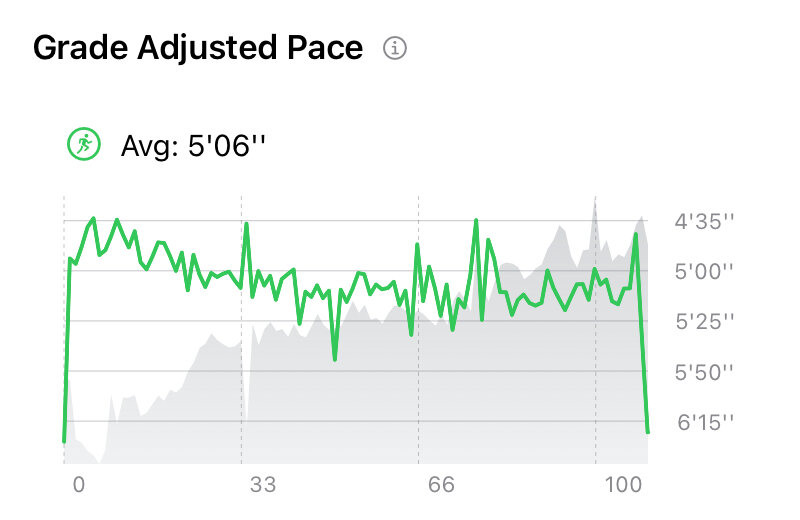
The header is the run’s average GAP. The chart is the GAP trace, in green, over the same grey elevation shape the pace and heart rate charts carry, so you can see the ground under every number. Tap or drag on it to read the GAP at any moment, the same as the other charts.
The reading is in the comparison with the pace chart just above it:
- Where GAP sits above the pace line — faster — you were climbing. The steeper the hill, the bigger the gap between the two.
- Where GAP sits a little below it, you were descending and the road was helping.
- Where the two lines match, the ground was flat and the pace was the whole story.
Two averages, one sentence#
Put the run’s average pace next to its average GAP and you get a one-line verdict on the course:
- GAP faster than pace — a hilly route. The run was harder than the pace suggests, and by about that much.
- GAP slower than pace — a net downhill. The pace flattered you a little.
- The two within a second or two — flat, or a loop where the climbs and descents cancelled out. The race above is this case.
That’s the number to compare across runs on different courses. Two 10 km runs at 5'20’’ pace, one flat and one over a ridge, are not the same run, and their GAPs will say so where their paces don’t.
Worth knowing#
- The average is free, the trace is Pro. Both use the same calculation; Pro adds the chart, not a different number.
- It depends on the elevation your watch recorded. A run whose elevation profile looks wrong — a spike where there was no hill — will have a GAP spike in the same place. The elevation card is where to check.
- Every split has its own average GAP, on the split’s detail screen, free. That’s the one to open when one kilometre looks slow — it says in a line whether the hill did it.
- GAP is a training number, not a race number. Your finish time is your finish time. GAP is for judging the effort behind it, and for comparing your own runs on different ground.
- The ⓘ beside the heading explains uphill, downhill and the average comparison in the app’s own words, in case you want it on the run rather than here.
The metric behind it: Grade Adjusted Pace explained
Get the app
Stop being discouraged by hills.
Every run shows what its effort was worth on flat ground. The average is free; Pro draws the whole trace so you can see exactly which climb cost what.
↓ Download Apex Run